Around the world In 2020 about 5 million children under the age of 5 years died. Of those deaths, 2.4 million occurred among newborns (in the first 28 days of life).
The leading causes of death in children under 5 years can all be prevented or treated with access to affordable interventions in health and sanitation. That’s why Rotary makes high-quality health care available to vulnerable mothers and children so they can live longer and grow stronger.
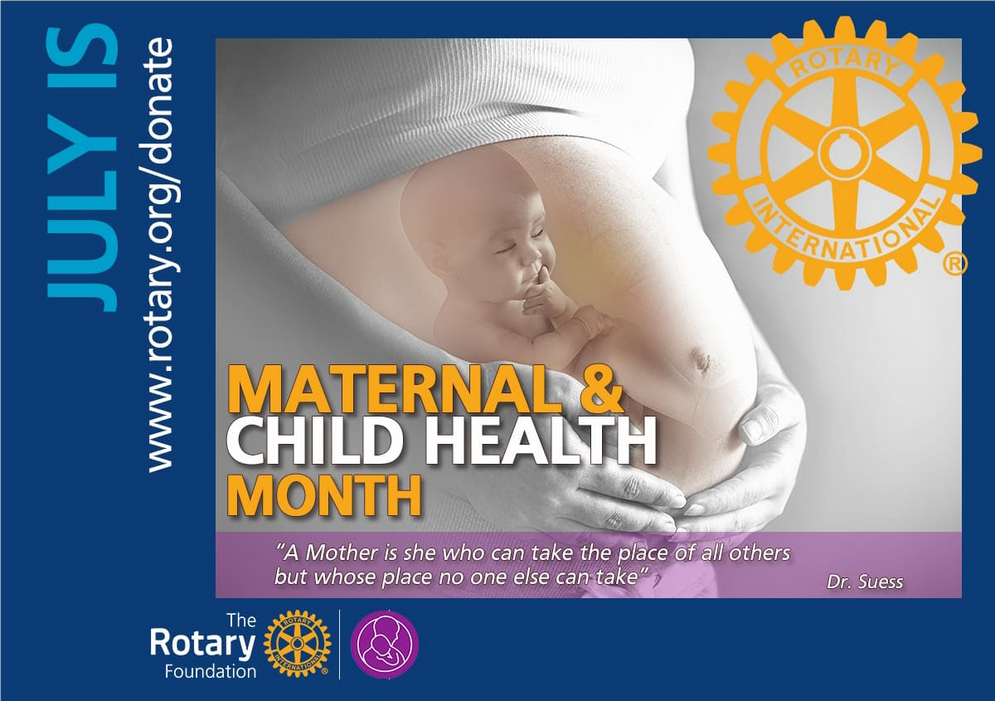 In July Rotary recognizes one of its seven Areas of Focus: the need to improve maternal and child health and the work we are all doing to meet that continuing challenge.
When mothers are empowered and healthy, and in turn, their families, poverty and hunger can be reduced.
Rotary programs improve women’s access to doctors, nurses, midwives, or community health care workers.
Rotarians distribute clean birth kits and train health workers in safe delivery of babies. They also teach mothers how to breast-feed, promote immunizations and regular checkups, and distribute insecticide-treated bed nets.
By giving communities the help and training they need to take control of their own maternal and child health care, Rotary makes a positive impact on the lives of mothers and children in need, with the support of The Rotary Foundation. In the past year alone our Foundation contributed US$7.5 million to this cause.
With increased speed of the internet, telemedicine – the use of information technology to provide health care from a distance – now reaches remote communities in some of the world’s poorer communities.
Physicians can use telemedicine to connect with patients remotely, even examine a patient using a robot, and consult with other physicians all over the world. A global grant in the past, from The Rotary Foundation, for instance, has enabled a team of health care professionals from Nigeria to be trained in telemedicine.
Rotary also takes action to reduce maternal deaths by 30% through family planning and ultimately to empower women for their sakes and the benefit of their communities.
Rotary members are strengthening community health systems and increasing the capacity of community health workers in the Democratic Republic of Congo, Mozambique, Nigeria, and Zambia.
In Sri Lanka, Rotary members collaborated with the ministry of health to support policy change an improve cervical cancer screening protocols. They advocated for HPV vaccination which is now part of the national immunization program.
Rotary members are working to immunize 100,000 children across nine remote Pacific Islands by working with the local health system to create sustainable delivery of vaccines.
Closer to home, in our District 5040, we enjoy the highest standards of living and health care. We do not face the sometimes high risks – to mothers as well as children -- bringing children into the world.
But in many of our communities our Rotary clubs, including ours, look after children and youth from families in need who may go hungry. We support shelters for abused women who may be mothers with children. We support the purchase of health care equipment. We create lasting impact.